The journal
How do you check bamboo earring hooks and backs for compatibility?
Identify the exact earring fitting, confirm any supplied back and check its intended compatibility. A familiar stud back does not establish a match for a bamboo earring hook.
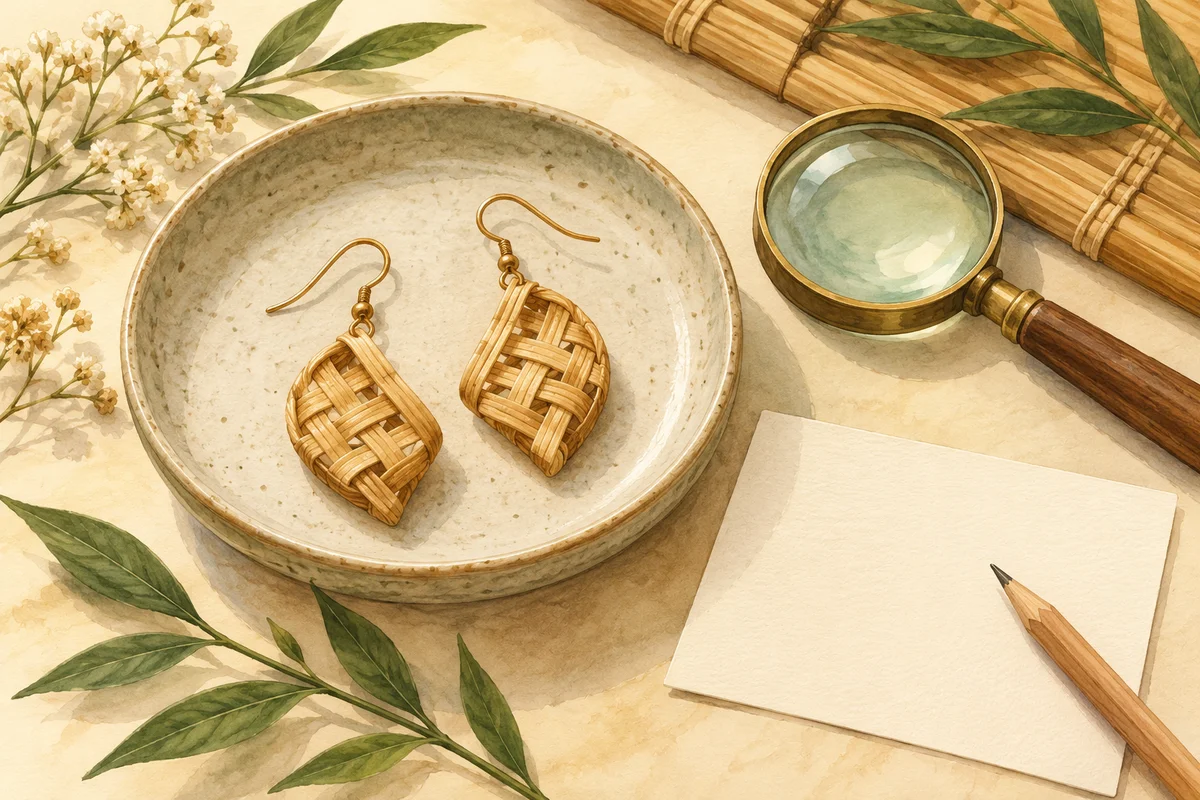
At a glance
Start with the exact earring fitting, then confirm the back’s intended use and whether it is supplied. A hook, a straight stud post and a clip are different fittings; owning pierced earrings does not establish that a new hook or an old back will suit your usual setup. KineTimber’s checked ER-02 and ER-16 pages specify alloy ear hooks, but do not publish wire diameter or a compatible back reference. Use product-specific information and an unforced check off the ear. Leave compatibility unconfirmed when the required details are missing.
Is the earring a hook, a stud or a clip-on?
Identify the fitting that meets the ear, rather than the shape of the bamboo decoration. A ring-shaped woven body does not establish a hinged hoop closure. Fire Mountain Gems lists fishhook wires, leverbacks, studs and clip-ons as separate finding categories; those names help describe what to check, but do not identify a KineTimber model by themselves. Read the exact product’s fittings text and front, side and reverse views together. If a clasp is hidden, request that view rather than guessing its opening action from a styled photograph.
What do ER-02 and ER-16 actually confirm?
Both checked product pages describe a handwoven natural bamboo body with alloy ear hooks. ER-02 is the natural-and-forest-green knot and ER-16 the natural long drop. These are decorative differences, not evidence of different hook diameters or back systems. Neither checked text specifies wire diameter, a back model, included spare backs or a clip-on option. The listed total length includes the hook; it cannot be used to calculate wire thickness or clearance behind the ear. Keep those missing fitting details separate from the published body description.
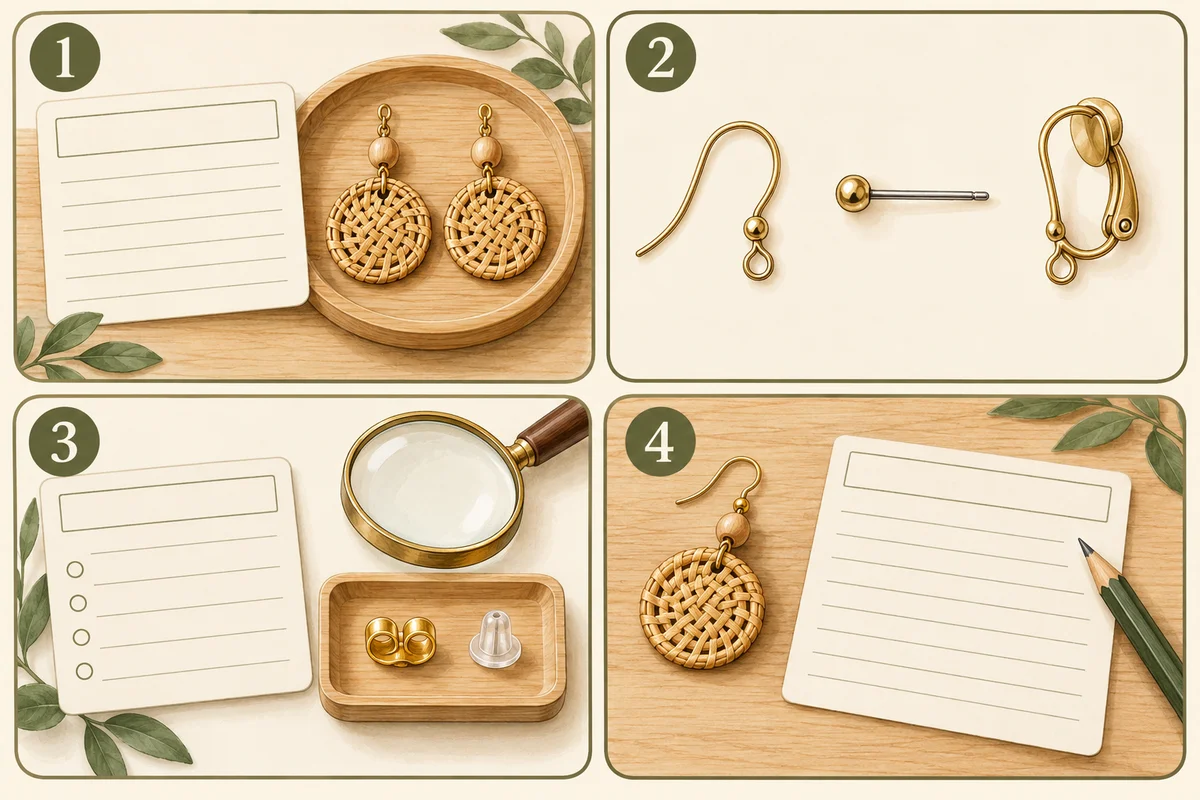
Does wearing studs already establish that a hook will suit me?
No. A familiar stud records one fitting you use; it does not document the new hook’s thickness, curve or tail. First decide whether the new item uses the kind of fitting you intend to wear. If you require a clip-on, do not treat a hook listing as a confirmed alternative. Compare product information with the specification of a fitting you already know, where available, without using your ear to test an unknown diameter. This checklist addresses accessory compatibility; it does not assess a piercing or establish personal suitability.
Can I reuse any earring back I already own?
Do not assume interchangeability. Check whether the back is intended for a straight post or an ear wire, and ask for its stated compatibility with the exact fitting. Rio Grande’s friction-ear-nut listing gives an accommodated post-size range: a useful example of component-specific information, not a specification for KineTimber hooks. A stopper’s outside size, colour or ability to start sliding onto a wire does not by itself establish the intended match. Do not squeeze, drill or reshape a spare back to make it fit. No back in this article is endorsed as a universal replacement.
Does a photograph prove that backs are included?
Use an explicit item-specific inclusion statement. A small part may be obscured in a photograph, while a visible accessory may be a styling prop; either way, the image alone is an incomplete delivery record. KineTimber’s checked product pages say styling accessories are not included unless confirmed in the final specification, and their text does not explicitly list separate backs. That is an unanswered inclusion question, not proof that a back is absent. Confirm quantity, material and compatible reference together if a separate back is part of your buying decision.
What can I check on a tray before wearing?
Check identity, condition and the stated operating method with the earring off the ear. Place the received pieces on a clean tray, compare them with the exact product information, and look for an obviously bent hook, a loose connection or a back whose identity is unclear. Only check an original or explicitly confirmed compatible back in the manner its supplier describes, without force. Stop if it resists or requires bending the hook; record the issue instead. Do not pull on the woven body or shake the earring to simulate a retention test. This is a visual component check, not a wear or security test.
Can I replace the hook or convert it to a clip-on?
Treat conversion as a separate modification question. A decorative loop or visible connection does not establish that the hook is designed for removal, or that another fitting will preserve the intended orientation. ER-02 and ER-16 do not publish a hook-replacement or clip-conversion method in the checked text. Do not open a connecting ring, cut a wire or use pliers as part of this checklist. If a different fitting is essential, obtain a model-specific answer about whether a supported option exists before selecting the item. Another merchant’s clip-on component is not evidence of a compatible KineTimber conversion.
What should I record before deciding?
Record the exact ER reference, fitting type, confirmed back reference, inclusion and source date on one sheet. A useful single request is: “For this ER version, what is the ear-hook wire diameter, is a compatible back supplied, and what back reference and instructions apply?” Keep a merchant’s written answer separate from your own observation. If an essential compatibility fact remains unanswered, wait for that fact rather than choosing a substitute by appearance. The linked pages were checked on 26 October 2026. KineTimber editorial · 26 October 2026 · Prepared with AI assistance.
Put the guide into practice
Use one sheet for the exact earring version and its proposed back. Record a published fact, supplier answer or observation in the relevant row. Leave unanswered fields open; this worksheet is a component record, not a piercing assessment or retention test.
- Identify the exact ER version and fitting from its text and front, side and reverse views.
- Confirm whether a back is supplied, its reference and its intended fitting compatibility.
- Off the ear, compare received parts on a clean tray and follow only the confirmed operating instructions without force.
- Save the source date and unresolved question; obtain an item-specific answer before selecting a substitute.
| What to examine | How to interpret it |
|---|---|
| Exact earring | ER reference/version: ____; page/date: ____. |
| Fitting identity | Hook/post/clip/other: ____; side/reverse view source: ____. |
| Wire or post specification | Diameter with unit if supplied: ____; supplier/source: ____; unconfirmed detail: ____. |
| Back and inclusion | Back reference: ____; supplied quantity/material expressly confirmed: ____. |
| Intended match | Back intended for which fitting/range: ____; written confirmation/instructions: ____. |
| Off-ear observation | Received parts match description: ____; visible condition: ____; resistance or reason to stop: ____. |
| Decision and next question | Essential fact still needed: ____; dated answer: ____; compatible option confirmed/pending: ____. |