The journal
Will your phone fit in a bamboo bag? What should you measure?
Measure your phone with its case, then check the bamboo bag opening, lining and usable space. Use a worksheet before assuming it will fit.
At a glance
Outer bag dimensions cannot confirm that your phone fits. Measure the phone with its everyday case and accessories, then check the narrowest opening, usable interior and closure. Passing through the opening and fitting alongside your wallet and keys are separate checks. Where internal measurements are missing, record the unknowns before choosing.
Should I measure my phone with its case?
Yes. Measure the phone exactly as you carry it: with its case, attached card holder, grip or other accessory that stays on. Record length, width and thickness in the same unit, including protruding parts rather than just the screen size. If you sometimes carry a second phone, make it a separate item on the list. A removable accessory can be recorded in a second configuration, but do not assume you will remove it every time. The useful measurement is your actual carried object, not a model name or diagonal screen dimension.
How do outer size, opening and usable interior differ?
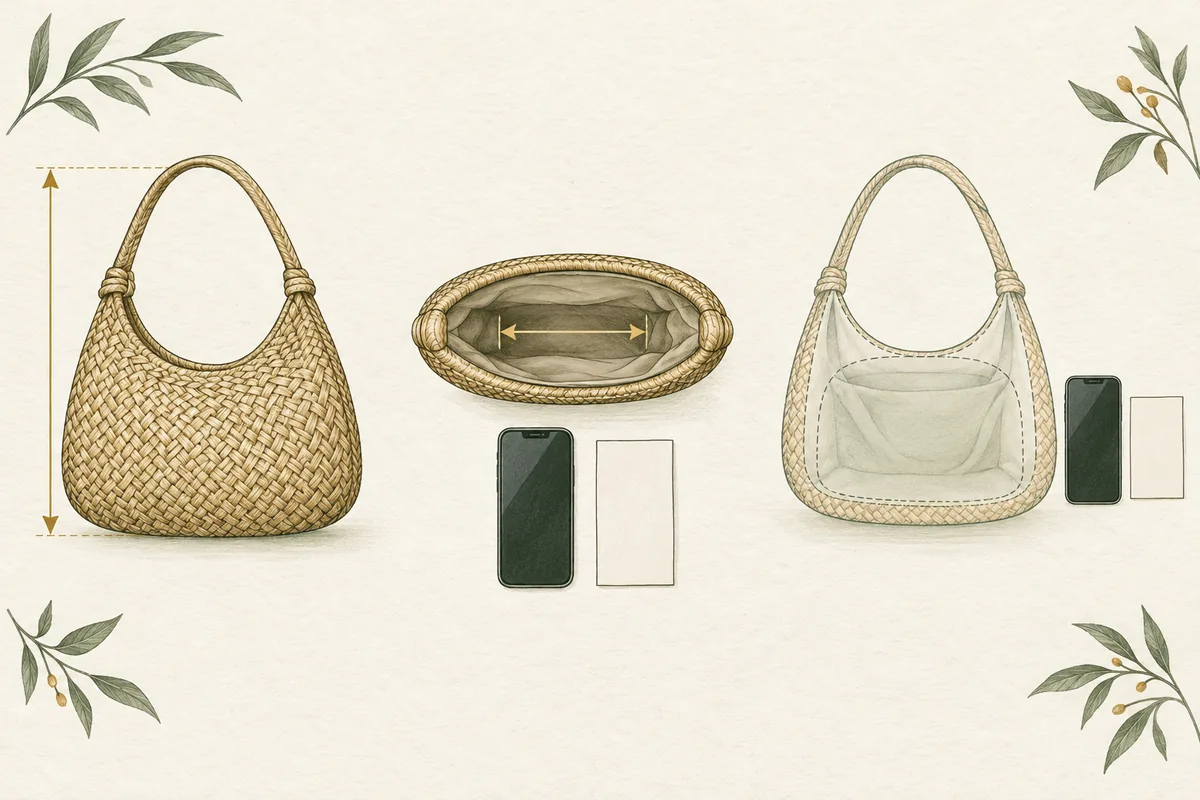
Outer size describes the bag’s outside envelope; the opening is the route an item must pass through; usable interior is the space available after construction and lining are considered. Check all three rather than subtracting an invented allowance from the catalog. WB-03 is listed as 29 × 13 × 24 cm and WB-18 as 17 × 17 × 14 cm, both in L × W × H order with height excluding the handle. These are catalog dimensions, not internal measurements or phone-fit test results. A wider outside does not automatically mean an equally wide opening.
Does the stated height include the handle?
Read the measurement label on the exact product page. Handle-inclusive height is an outside dimension and cannot be treated as usable depth inside the bag. In the current KineTimber bag catalog, WB-05’s stated height includes the handle; the other bag entries exclude it. Even a handle-excluding measurement does not establish internal vertical clearance, because the base, lining and closure still matter. If you want the phone upright, record that orientation and ask for the relevant interior height. Do not use a model’s hand or body as a measuring scale.
How do lining and closures affect the check?
Check whether the object can enter without catching or requiring the lining to be pulled aside, then whether the normal closure works with the intended contents inside. Fabric folds and a closing section may occupy part of the space, but their effect must be checked for that style. WB-18’s description refers to a drawstring silhouette; that does not establish a removable lining or a measured opening. Do not stretch the weave, force a frame or leave the closure under tension to make a phone fit. Easy access should be checked separately from merely fitting once.
How can I make a useful everyday-items worksheet?
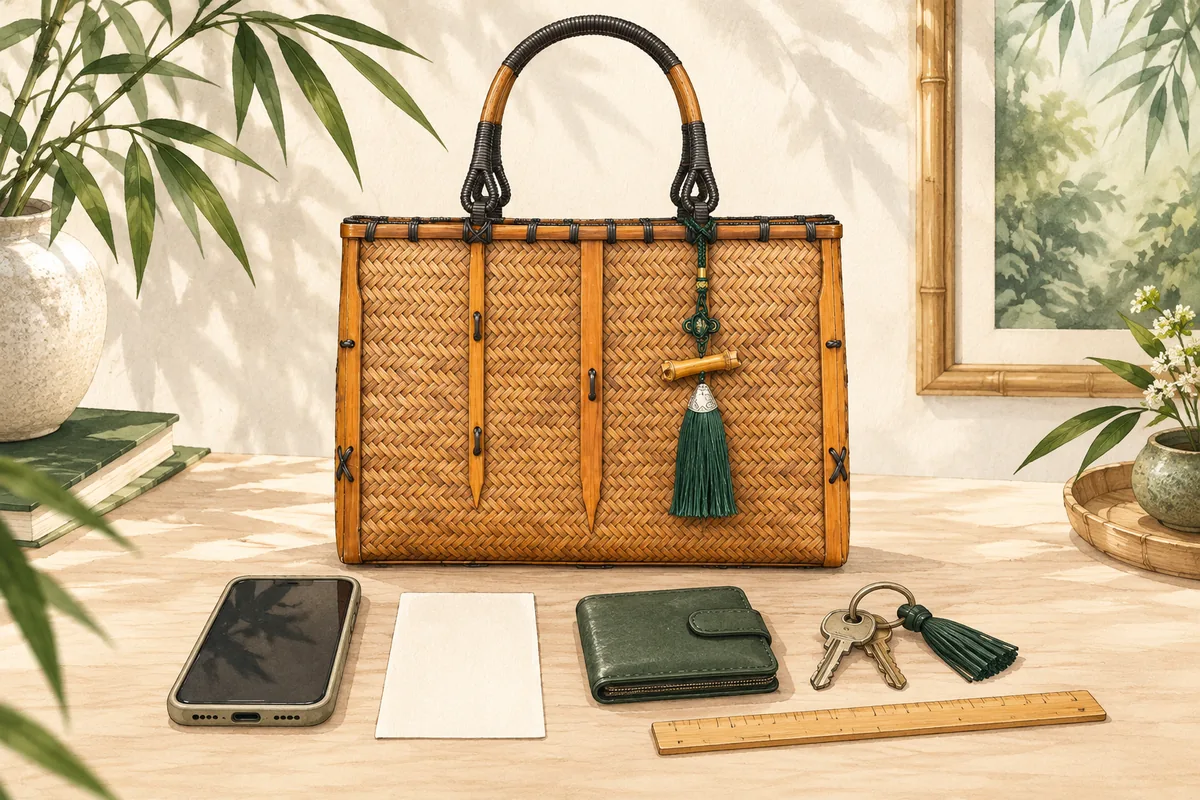
List the objects you genuinely take together, then measure each in its everyday condition: a closed wallet, keys with their usual holder and the phone with its case. Write whether each item is essential or optional. A paper rectangle made to the phone’s length and width can help you describe its footprint, but label it as a two-dimensional template: it does not reproduce thickness or prove a bag’s capacity. Keep the intended arrangement on the worksheet, such as phone upright beside wallet, so the question covers the group rather than each object alone.
Can a styling photo prove room for a tablet or bottle?
No. A photograph may show a bag’s shape or styling, but it does not establish the opening, internal depth or space for several objects. AI styling illustrations are especially unsuitable as loading evidence. Measure a tablet with its cover and a bottle across its widest part, including the cap; record them as separate needs. Fitting geometrically also does not confirm a permitted carrying weight or suitability for liquid containers. No phone, tablet or bottle compatibility is claimed for WB-03 or WB-18 here. Their linked product pages are starting points for comparison, not verified packing demonstrations.
What should I ask when interior measurements are missing?
Ask one concrete fit question using the WB reference, your measured objects and their intended arrangement. Request the narrowest usable opening, relevant interior dimensions and confirmation that the normal closure works with that group. Ask whether any answer comes from measurements, a photograph or an actual insertion check; these are different kinds of evidence. If only exterior dimensions are available, mark the fit as unconfirmed. When you already have the bag, start with an empty-bag inspection and try your own items gently, without pushing against the weave or forcing the closure.
Put the guide into practice
Copy this worksheet for each candidate bag. Keep item measurements separate from catalog dimensions and leave unknown fields blank. Check entry through the opening first, then the full arrangement and normal closing.
- Measure phone, closed wallet and keys in their carried condition.
- Record the WB reference, catalog measurement order and handle-height definition.
- Check opening and usable interior; write unconfirmed when information is missing.
- Check the items together, normal closure and access without forcing the bag.
| What to examine | How to interpret it |
|---|---|
| Phone with case and attached accessories | Length × width × thickness: ____; orientation: ____ |
| Closed wallet and keys with holder | Each item’s dimensions: ____; essential or optional: ____ |
| Candidate bag | WB reference: ____; opening: ____; usable interior: ____ |
| Whole-group check | Normal closure and easy access: ____; evidence or unknowns: ____ |