The journal
Can a woven bag snag delicate clothes, and what should you check?
Check woven edges, handle joints and clothing contact points before choosing a bamboo bag. Use the photo checklist for delicate outfits.
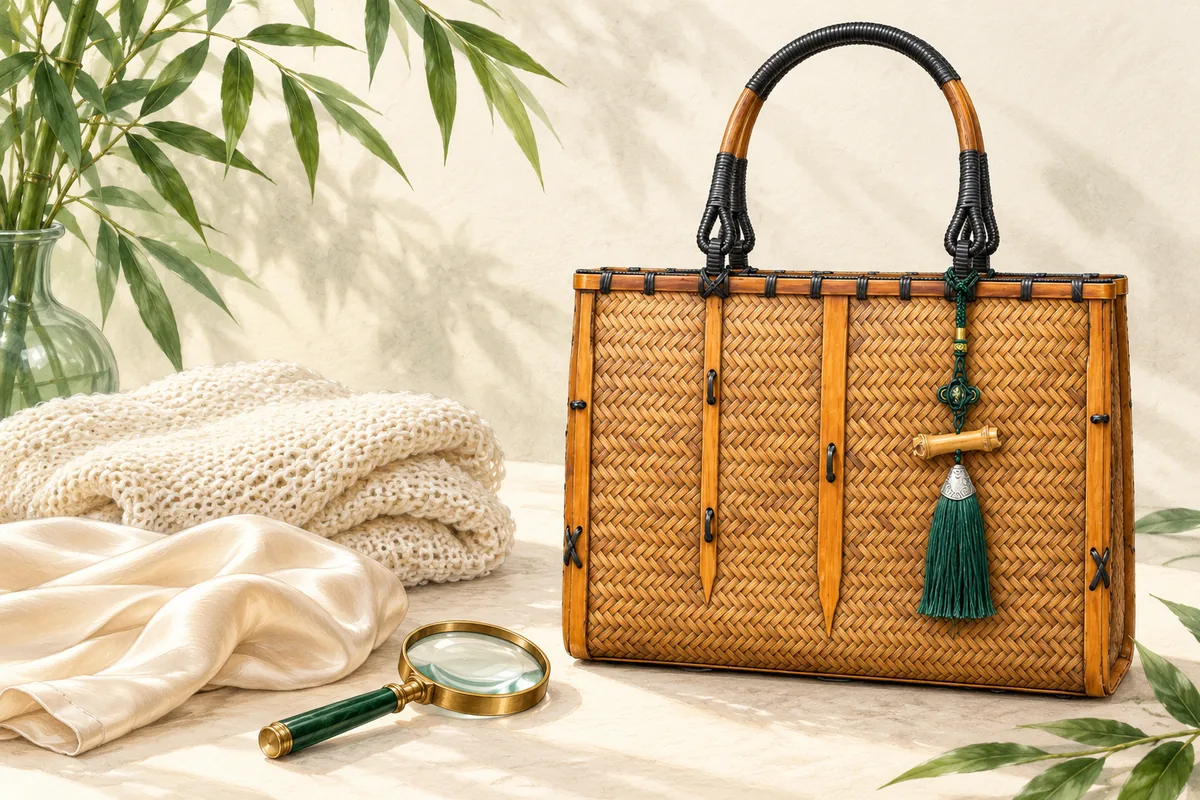
At a glance
A woven bag cannot be assumed snag-free around delicate clothes. Inspect the actual edges, handle connections and surfaces that may touch your outfit, then consider how you carry that style. Do not rub a favourite knit or silk garment against the bag as a test. If you see a sharp split or loose component, pause use and record it.
Which edges and connections deserve a closer look?
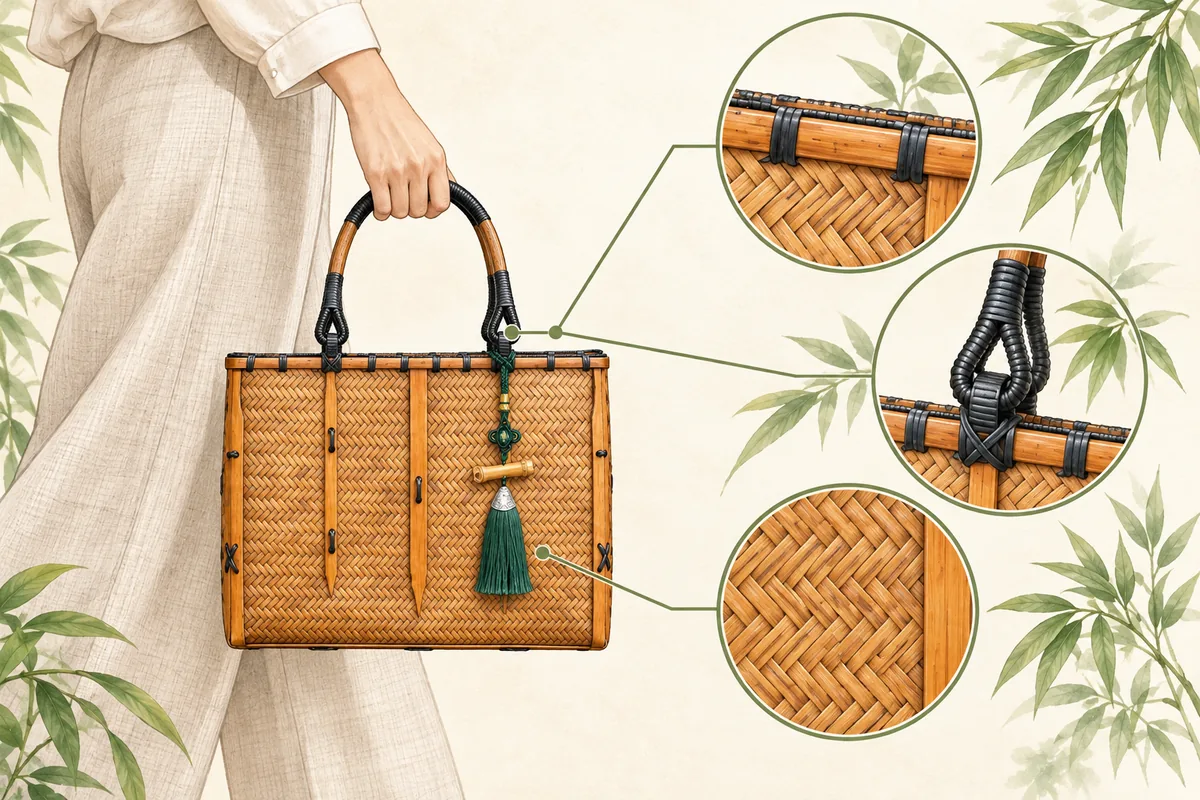
Look at the rim, corners, base edge and handle connections, plus any trim or fitting that sits near clothing. Ask for views of both the face worn toward the body and the opposite face. The question is whether you can see a projecting end, split strip or loose component in the contact area, not whether every woven line is perfectly identical. KineTimber’s quality guide separates weave appearance, edges and components. A small variation in a handmade pattern does not, by itself, explain away a sharp edge or establish that the piece is suitable for your outfit.
How does carrying position change contact with clothes?
Map the contact for the carrying method the exact style supports. A hand-carried bag may meet a skirt, trouser leg or coat when you walk or sit; keeping it clear of the garment can reduce that contact. Shoulder or crossbody carrying is relevant only when that product’s actual specification provides the required strap. Do not infer a strap from a generic illustration or add one to a frame bag. For a confirmed shoulder style, check the body-facing surface and attachment points. Consider movement as well as a still pose: where will the bag rest when you sit down?
Why check first when wearing knitwear or silk?
Treat an outfit with exposed loops, loose yarns or a delicate surface as a reason for closer inspection, not as a fabric to rub against the bag. Consider the garment’s construction and its own care instructions; the word silk or knit does not establish one identical behaviour for every fabric. If your planned outfit must stay clear of a woven edge, choose a carrying position that maintains that separation or select another pairing. This is a practical precaution. It is not a measured risk rating, a textile test or a statement that every bamboo bag will snag clothing.
Can an AI styling image confirm that a bag will not snag?
No. A styling image can suggest a visual pairing, but it cannot prove the condition of the actual edge or what happens while the bag rubs against a garment. AI-created editorial illustrations are not friction tests, close-up product inspection or evidence of a snag-free finish. Use the product’s detail views for shape and visible components, and request a clearer view if the contact surface is hidden. Even a clear photograph has limits: it shows what is visible from that angle and does not replace inspecting the item you receive or establish a tested performance claim.
How should I record a loose end, split strip or uneven edge?
Start with the WB reference and an overall photo that shows where the area is located. Add a well-lit close-up from more than one angle, keeping the component in its current position. Record whether you noticed it before use or after a specific event, and describe the location in plain terms, such as lower body-facing corner or handle connection. Do not pull a strand, rub it on clothing or keep carrying a visibly damaged bag to see what happens. A sharp split or loose fitting calls for pausing use while the item is assessed.
Can I sand, trim or glue a rough area myself?
Do not make an improvised repair. KineTimber’s care instructions do not authorise sanding, cutting strands, applying glue or adding a coating. Keep the area as found and obtain advice for the exact style before changing it. A repair suggestion for another brand or another material is not permission to alter this bag. For normal surface dust, use the confirmed dry cloth or soft brush routine gently; that is cleaning, not a way to remove a projecting structural piece. Do not describe a visible split as harmless solely because the bag is handmade.
What should I request before buying for a delicate outfit?
Request clear views of the rim, base corners, body-facing surface and handle connections for the WB style you are considering. State the garment and intended carrying position, then ask about any visible projecting edge or uncertain component. For WB-03, the catalog lists natural bamboo and natural wood; for WB-18, natural bamboo and textile. Neither composition proves snag resistance. Ask whether any performance statement is supported by a relevant test rather than interpreting a smooth-looking scene as evidence. If the necessary view or answer is unavailable, keep that point unconfirmed when deciding on the pairing.
Put the guide into practice
Use this contact-point checklist with the actual style and your intended outfit. Fill in what is visible, the view you still need and any unanswered question. It is a buying and inspection aid, not a fabric-friction test.
- Record the WB reference, garment construction and supported carrying method.
- Map where the rim, corners and joints could meet the garment while moving or sitting.
- Check detail views and the received item without rubbing a delicate garment against it.
- For sharp splits or loose parts, pause use, photograph the area and avoid improvised repairs.
| What to examine | How to interpret it |
|---|---|
| Rim and upper corners | Close-up needed: ____; projecting end or uncertainty: ____ |
| Body-facing surface and base | Clothing contact while walking or sitting: ____; view required: ____ |
| Handle joints and any specified fittings | Condition visible: ____; question for this WB style: ____ |
| Pairing decision | Carry clear of garment, choose another pairing or leave unconfirmed: ____ |