The journal
Can you wear bamboo earrings with glasses or headphones?
Check the space around the hook, glasses arm and headphone cushion before choosing bamboo earrings. Compare three real ER dimensions with an original contact-space record.
At a glance
Possibly, but neither a bamboo material label nor an earring’s total length confirms compatibility with your glasses or headphones. Check where the exact hook, back and woven body would meet your own equipment, and keep the normal fit of that equipment. Compare published dimensions as a starting point; do not squeeze, bend or force jewellery into a space that presses on it.
Which contact points matter first?
Check three areas separately: the hook and fitting behind the ear, the woven body beside the jaw or collar, and the equipment’s contact surface. A small front view can hide a projecting back or hook. Record the precise point where items meet instead of assuming that every drop earring behaves like a stud. Compare both sides because your equipment may sit differently.
Does a length including the hook equal the hanging drop?
No. KineTimber’s ER measurements below explicitly include the hook. They are not a measurement from your piercing to the bottom while worn, nor a record of the separate woven body’s thickness. Ask which endpoints and components the stated width covers. A photograph on a model is not a substitute for those definitions or a trial with your equipment.
How do the three real ER examples differ?
ER-01 is listed at 6.5 × 4 cm, ER-02 at 8 × 3.7 cm and ER-16 at 6 × 2 cm, each with length including the hook. ER-02 therefore has a longer published outline but is not wider than ER-01. These are useful shortlisting distinctions, not weights, worn-clearance measurements or a ranking of comfort. Keep their actual product pages as the source.
How should I check the glasses I already wear?
Start with your glasses in their usual position and note where the arm rests behind the ear. Compare the earring’s hook and back view with that area, rather than matching colours alone. With an existing compatible pair, observe ordinary movements without forcing contact. If an item presses or catches, separate the items and keep the combination unresolved; do not bend a hook to make room.
Why do ear cups and ear hooks need separate checks?
Different equipment occupies different space: an over-ear cushion surrounds the ear, while another design may use its own ear hook. Read that exact equipment’s instructions. Beyerdynamic’s AMIRON 200 guidance conditions accessory use on keeping its ear hook unobstructed; that is advice for that model, not approval of every earring. Do not assume an ear-cup opening measurement proves that the complete assembly clears jewellery.
Can I use a paper outline before ordering?
A paper outline can compare published length and width on a table, provided you label it as a flat approximation and include the stated hook scope. Do not insert paper into a piercing or hold a rigid template against the ear as a fit test. A two-dimensional outline cannot represent depth, hook rotation or movement; it helps identify the dimensions you still need.
Does a light-looking shape guarantee a long comfortable session?
No. Appearance, material and dimensions cannot establish weight, individual comfort or a period of comfortable combined wear. A narrower style may still meet a glasses arm or cushion at an inconvenient point. The existing size-and-weight and hook/back guides address those separate facts. Do not treat an alloy description, a photograph or an AI illustration as proof of allergy suitability or equipment compatibility.
What should I ask and record before choosing?
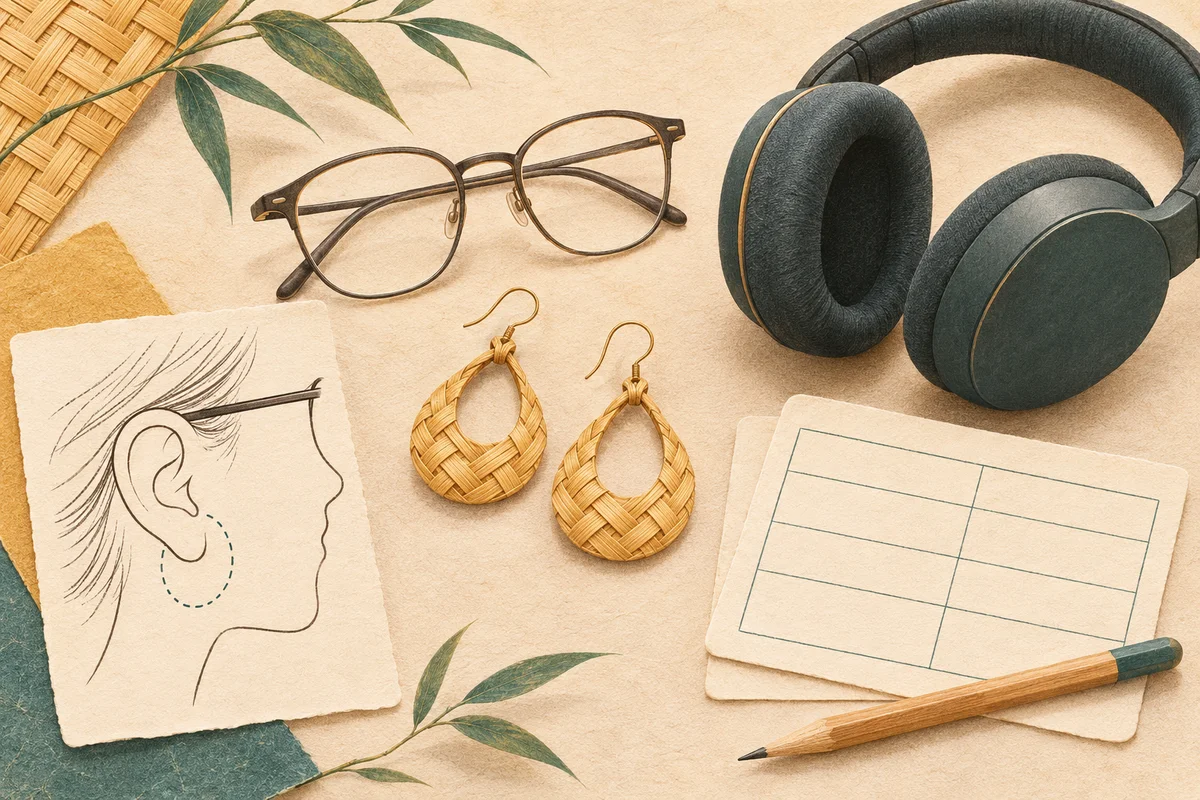
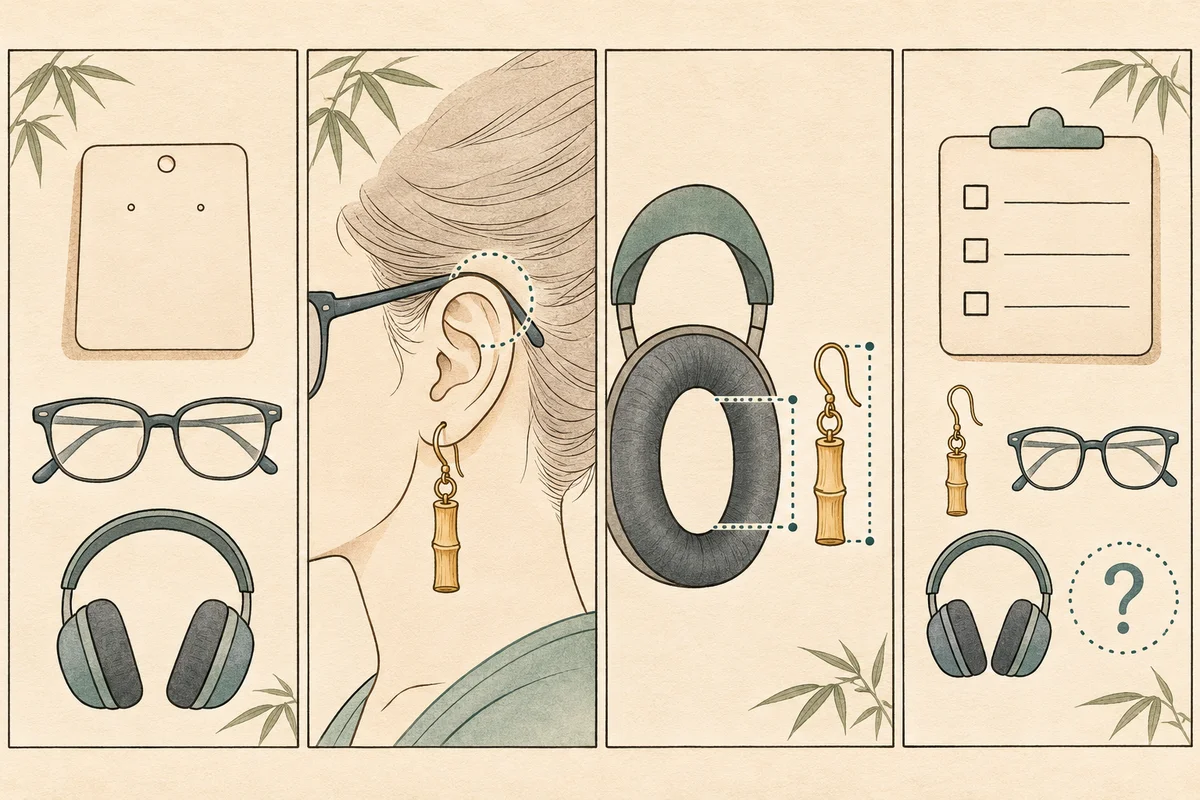
Record the ER reference, dimension endpoints, hook/back details and your equipment model, then identify the unresolved contact point. Ask for a relevant rear/side view rather than a general promise that earrings work with glasses. Save a conditional shortlist, or wait if a necessary detail is missing. The generic AI cover and four-panel diagram explain this record; neither depicts a measured KineTimber wearing trial.
Put the guide into practice
Use this original contact-space record for one earring/equipment combination. The four text steps explain the diagram. Published dimensions and your observations stay separate; no row certifies comfort, allergy suitability or device compatibility.
- Identify one ER reference and the exact glasses/headphone model.
- Record published endpoints and compare a flat outline away from the ear.
- Map the hook/back, glasses arm and cushion or equipment ear hook separately.
- Resolve necessary unknowns without forcing or modifying the jewellery.
| What to examine | How to interpret it |
|---|---|
| ER-01 | 6.5 × 4 cm, length including hook; worn contact untested |
| ER-02 | 8 × 3.7 cm, length including hook; longer does not mean wider |
| ER-16 | 6 × 2 cm, length including hook; not a headphone-fit result |
| Hook/back position | Rear/side view ___; endpoints ___; unknown ___ |
| Glasses arm | Model ___; normal resting point ___; contact ___ |
| Headphone arrangement | Model/mode ___; cushion opening or ear-hook area ___ |
| Ordinary movements | Known comfortable existing combination ___; pressure/catching ___ |
| Decision and evidence | Source/date ___; unresolved requirement ___; shortlist/wait ___ |