The journal
How do you keep small items in an open-weave bamboo bag?
Group loose items in your own closed pouch, then check the exact bag’s lining, closure and real opening. Use a small-item worksheet without assuming accessories are included.
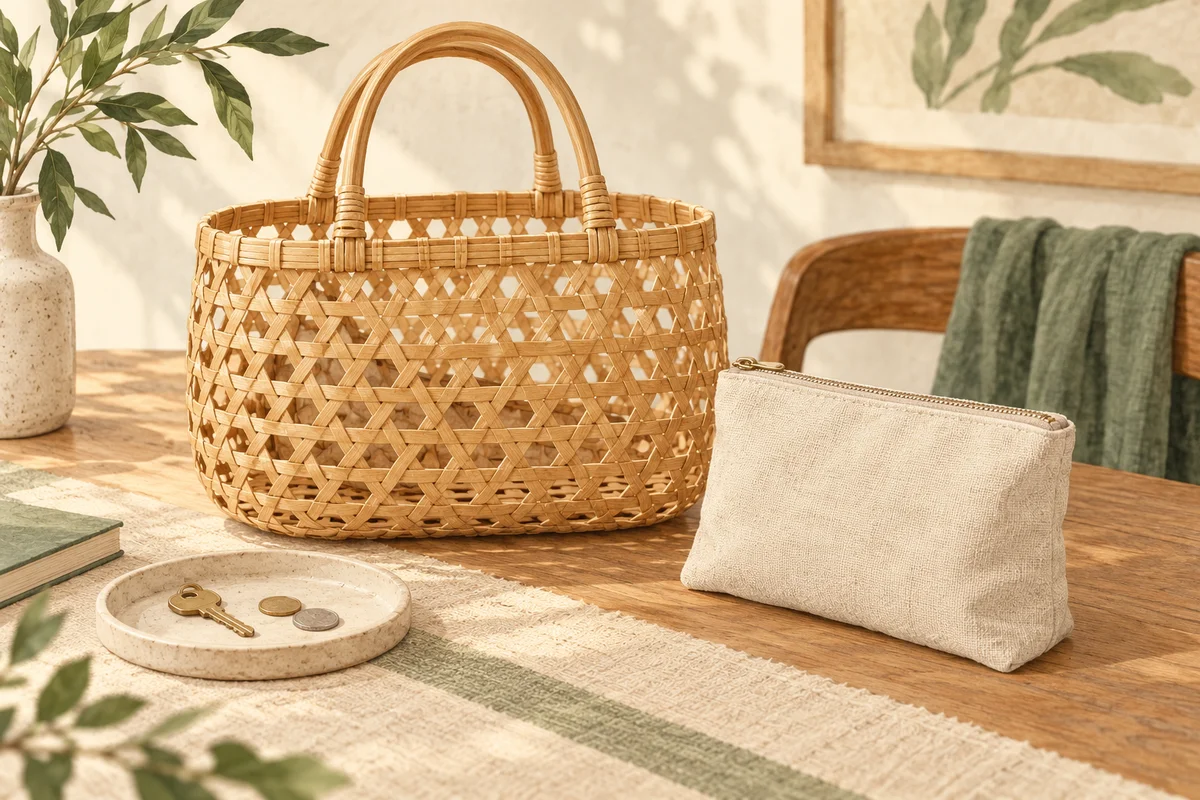
At a glance
Put loose small items in your own suitable closed pouch or case, then check that filled container against the actual bag. Confirm the exact style’s lining and closure separately: a textile detail does not establish full lining, and a drawstring top does not prove that every small item is contained. Check the real opening, interior and normal closure without stretching the weave or moving a lining out of the way. Record missing information before choosing. This is an organisation method, not a guarantee against loss.
Which small items should go in a separate container?
Start with loose coins, individual keys, small jewellery and other pieces you would otherwise put directly against the weave. Assign each to an appropriate holder, such as a coin purse, key case or jewellery case you already own; keep earbuds in their own case. This gives each item a defined place instead of relying on visible weave gaps. Check the holder’s own opening too. A container with an opening that remains exposed may still leave an item loose. These are editorial organisation suggestions, not tested containment results for a KineTimber bag.
What do WB-03 and WB-18 actually specify?
WB-03’s current product text describes a tassel frame tote in natural bamboo and natural wood, but does not specify its lining coverage or closure. That omission proves neither presence nor absence. WB-18 explicitly describes a drawstring top and blue botanical fabric, with natural bamboo and textile listed as its composition. It does not specify a removable liner, textile fibre, complete lining coverage or a measured closed opening. Use this contrast to ask model-specific questions, not to rank either bag’s ability to retain small items. Neither page confirms an included separate organising pouch.
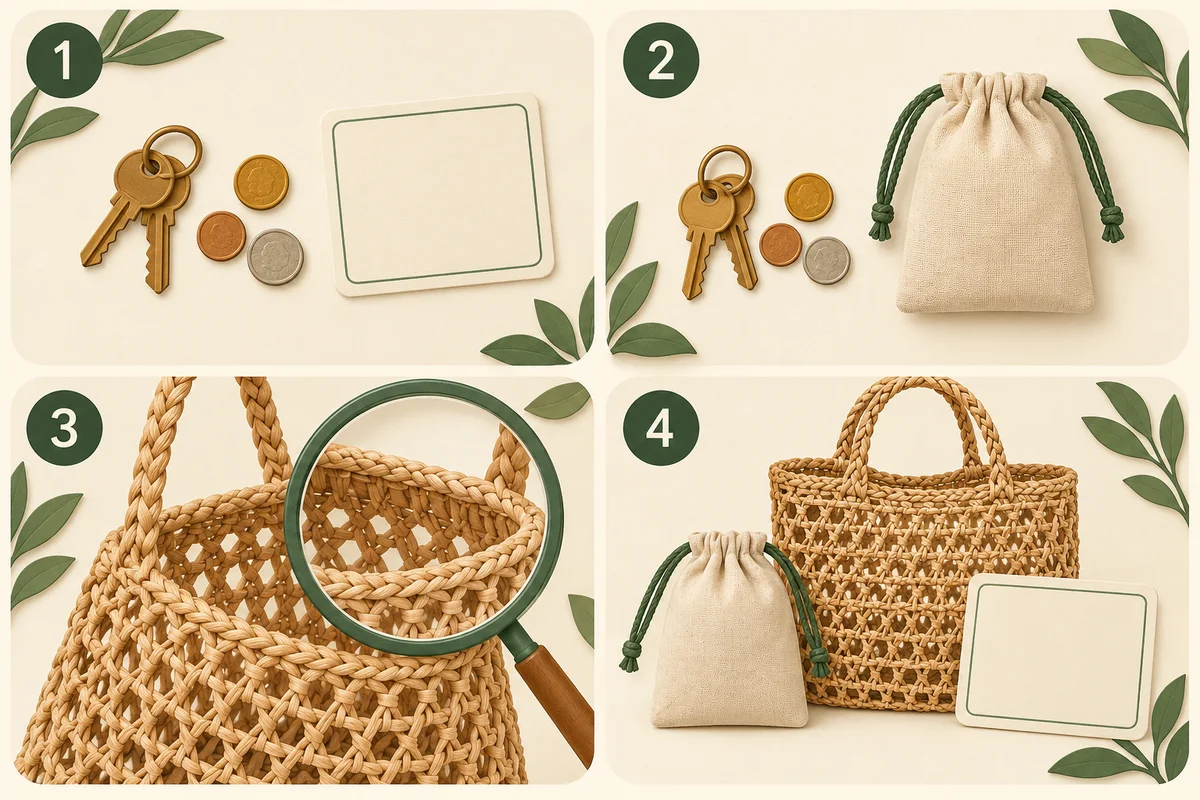
Does visible fabric establish a complete lining?
No. Fabric at the top could describe only that area; it does not document the base, side walls, seams or any internal pocket. Check those areas in clear views of the exact reference, then inspect the received item without pulling an attached section free. Ask how the textile is attached and which surfaces it covers if the description is incomplete. Do not assume it can be lifted out, reversed or washed separately. A small-item plan needs confirmed coverage and the container you intend to use, not a guessed lining construction.
Does a drawstring or another closure settle containment?
No. A named closure tells you about a component, not the size of every remaining gap or its behaviour with your contents. WB-18’s drawstring-top description does not establish a zipper, a complete seal or anti-theft protection. Check only the normal closing action supported for the actual item; do not tighten a cord forcefully to erase a gap. Observe whether your filled pouch obstructs the closing area or leaves fabric caught in it. Keep tiny items inside their own suitable closed holder rather than treating the bag closure as a tested small-parts barrier.
How should I choose my own organising pouch?
Choose for the items first, then check the filled pouch in the bag. Use a clean, dry container whose own closure works with those contents; a bulky bundle or exposed hard fitting may be awkward against the weave. Leave room for the bag’s normal closure and your hand to retrieve it. Do not tie, pin, glue or sew a pouch onto the bag as part of this method. The pouch is something you supply separately, unless the exact product specification explicitly includes one. Its empty dimensions alone do not establish the space it needs when filled.
How do I check the real opening without forcing it?
Set the bag upright on a stable surface and use its normal opening. Close your filled pouch first, then check whether it enters and comes back out without pressure, pulled lining or a stretched rim. If it rests inside naturally, check the bag’s normal closure with the intended contents present and note any interference. Stop if a part must bend or a fastening meets resistance. Do not shake, invert or deliberately spill the bag to test retention. A smooth entry check describes that arrangement only; it does not prove capacity, loss prevention or performance while carrying.
How can I keep access simple after grouping small items?
Give frequently used groups their own place and check the complete arrangement together. For example, record coins in your coin purse, keys in their case and earbuds in their case, then see whether the bag still closes normally with your other essentials. This example is a packing plan, not a claim that a named bag holds that set. Practise retrieving one container while the bag remains upright on the table. If reaching it requires pushing against the weave or pulling another component, reduce or rearrange the contents and record the change.
What should I ask if the product information is incomplete?
Ask about the exact WB reference and version: lining coverage and attachment, the normal closure, any remaining opening and explicitly included accessories. Explain which filled pouch you plan to use and request the missing interior or opening information without asking for a guarantee from exterior dimensions. Keep the answer and date with your worksheet; leave unanswered points unknown. Product detail views can clarify visible construction, but styling photographs and this article’s AI editorial illustrations cannot establish retention, pouch fit or supplied accessories. Use the separate phone-fit guide when your main question is a device’s dimensions.
Put the guide into practice
Complete one item-to-container row for each small-item group, then review the whole arrangement. Write unknown for missing specifications. This worksheet records your organisation and opening check; it is not a retention or capacity test.
- List loose items and assign each group to your own appropriate closed pouch or case.
- Record the exact WB style and confirmed lining, closure and included accessories; mark unknowns.
- With the bag upright on a table, check the filled container through the real opening without force.
- Check normal closure and retrieval with all planned contents; record interference or an unanswered question.
| What to examine | How to interpret it |
|---|---|
| Exact bag and evidence | WB reference/version: ____; product page and date: ____; merchant answer/date: ____. |
| Item → containment | Small-item group: ____ → own pouch/case: ____; filled size with unit: ____; own closure checked: ____. |
| Lining coverage and attachment | Base/sides/top confirmed: ____; attachment specified: ____; detail view or answer still needed: ____. |
| Bag closure and remaining opening | Closure explicitly described: ____; normal action confirmed: ____; remaining opening observed/unknown: ____; included pouch explicitly confirmed/unknown: ____. |
| Real opening → filled container | Upright table check/date: ____; enters and exits without force: ____; rim/lining interference: ____; unknown opening information: ____. |
| Whole arrangement and next decision | Other contents: ____; normal bag closure: ____; container retrieval: ____; reduce/rearrange/request detail: ____. |