The journal
Can a woven bamboo bag stand upright on its own?
Some woven bamboo bags stand on a level surface. Check the base’s contact area and the balance with your usual contents before choosing.
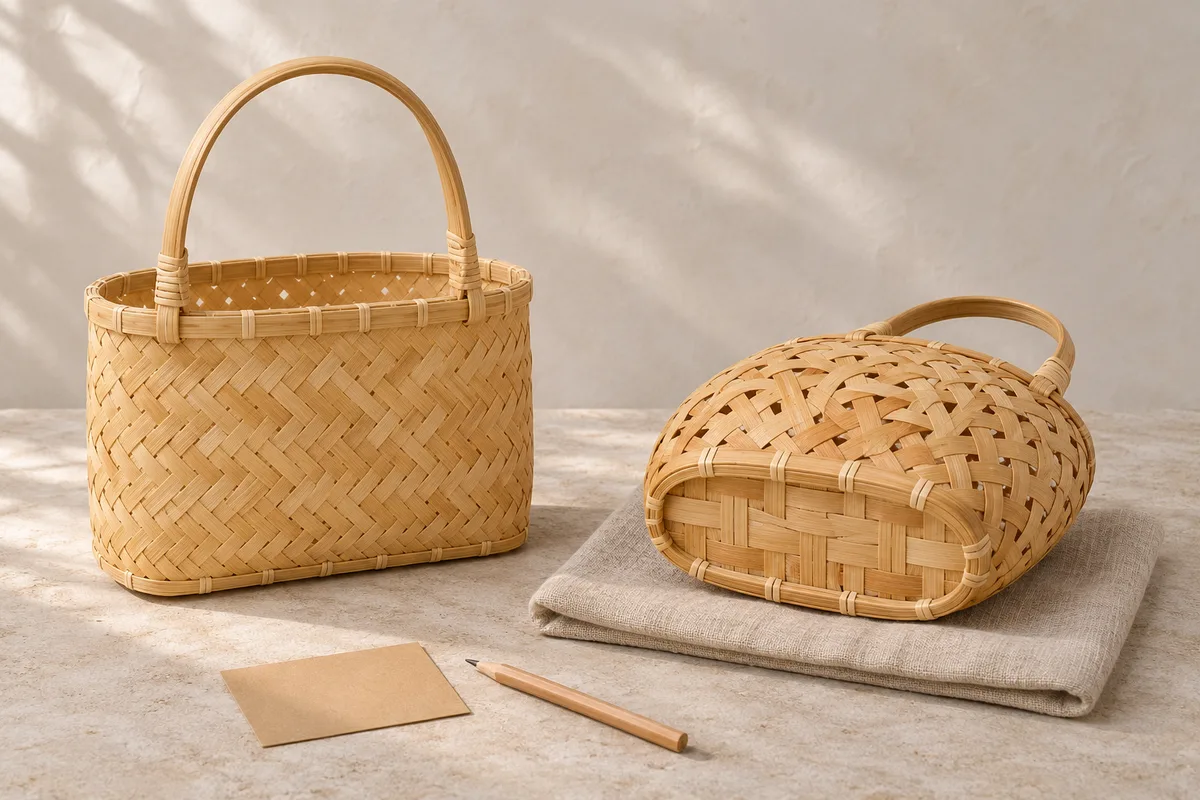
At a glance
Some woven bamboo bags can stand upright on a level surface. Check what actually touches the table, ask how the exact bag rests when empty and try your usual contents if you can.
What part of the bag actually supports it?
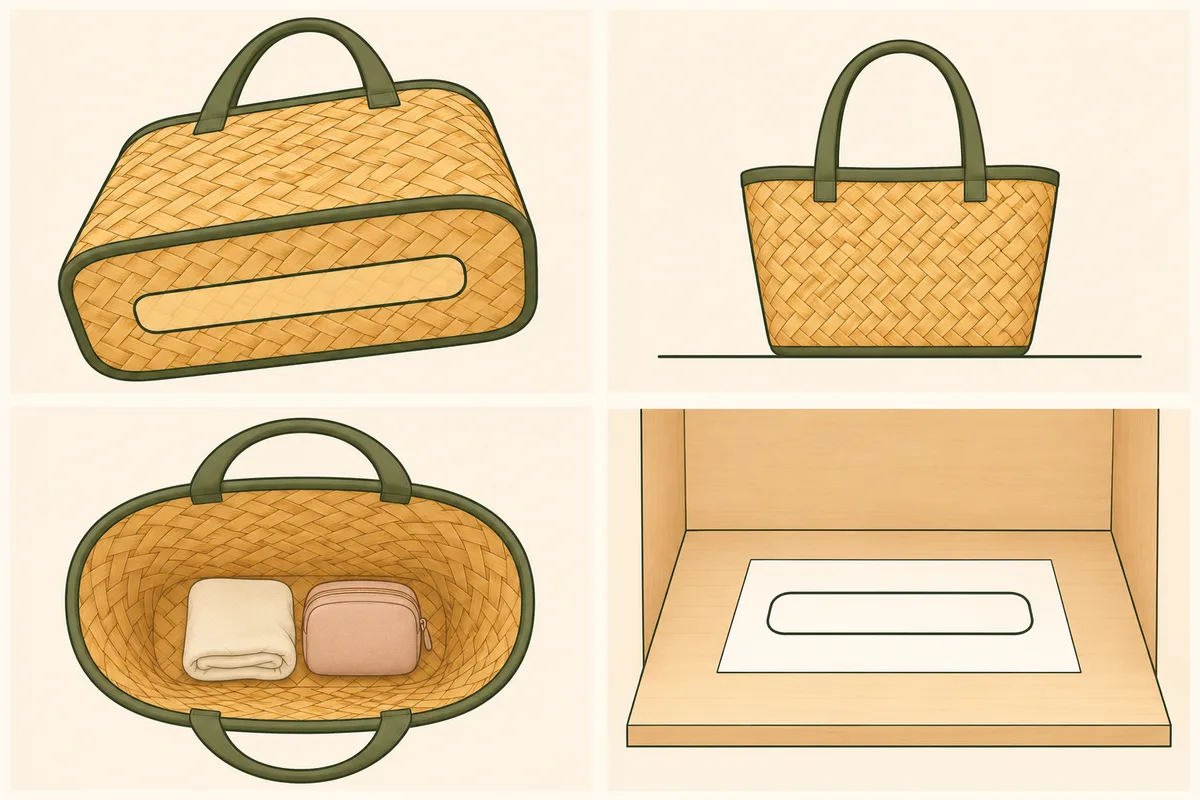
Look for the part of the underside that touches a firm, level surface. A flat panel, raised strip or feet can create a contact area smaller than the widest part of the bag. Rounded corners seen from the front do not show how the underside rests. An underside view together with a side view at table level helps you distinguish the outline from the contact points.
Can I work out the base from the listed width?
Use listed body dimensions to plan the space around the bag. For the base, ask for the length and width between its outer contact points. The brand Amish Baskets separates its tote’s wider top opening from its smaller wood bottom and answers the standing question separately. That gives you a way to ask about a woven bag, whatever its material.
What do the WB-03 and WB-13 dimensions tell me?
The WB-03 Tassel frame tote lists a body of 29 × 13 × 24 cm. The WB-13 Ring-handle handbag lists 24 × 6.5 × 19 cm. Both body heights exclude the handle. The dimensions describe the outside shape. Neither listing gives the contact footprint or a standing test with contents, so leave those two checks open for each exact style.
How do I check the bag when it is empty?
Set the empty bag well inside a clean, dry, level tabletop. Let the handles rest as they normally would, make sure nothing props up the bag, and keep a hand close while releasing it. Look from both sides for rocking, a tilt or part of the bottom lifting. This describes how that bag sits on that surface with its handles in that position.
Will the bag still stand with my everyday items inside?
Check again with the small items you actually intend to carry. Start with the heavier ones low and near the middle if they fit naturally. Look for a change in tilt when you add or remove a wallet or phone, or when a handle falls to one side. Avoid wedging objects into the bag to make it stand. The observation applies to those contents and that placement.
How much room should I leave on a shelf?
Trace the base on paper and compare it with the dry, usable surface behind the front edge. Check that the whole contact area stays on the surface and that the body and handle clear the sides and the shelf above. Leave space to set down and lift the bag with one hand in your usual way. If the shelf is narrow or the bag leans, choose a wider, lower spot.
Which photos or measurements should I request before ordering?
Ask for a photo of the exact style’s underside and an eye-level side view of the empty bag resting without a prop on a level surface. Ask which parts touch, their approximate span, and where the handles rest. A front photo can help you compare the look. It may leave the supporting points, rocking and loaded balance unknown.
What if upright placement matters and the base is still unclear?
Keep independent standing as a condition of your choice. Use the checklist to separate the points you have confirmed from the ones you still need. If you already own the bag and it rocks on your usual shelf, move it to a dry, level spot where it can rest in its natural shape without pressure. Compare a different style if you need it to stand on that shelf.
Put the guide into practice
A bag that stands empty for a photo may lean when you pack it or put it on a narrow shelf. Check the base, the surface and your usual contents separately.
- Inspect the underside and mark which parts actually touch the surface.
- Observe the empty bag on a clean, dry, level surface.
- Place your usual small items low and near the center when they fit naturally, then check again.
- Compare a paper outline of the contact area with the usable shelf space.
| What to examine | How to interpret it |
|---|---|
| WB-03 Tassel frame tote | 29 × 13 × 24 cm body, height without handle. Contact footprint to confirm. |
| WB-13 Ring-handle handbag | 24 × 6.5 × 19 cm body, height without handle. Contact footprint to confirm. |
| Points that touch | Note the panel, raised strip or feet and the contact span. |
| Empty bag | Record the surface and handle position. Note rocking or lean. |
| Usual contents | List what you carry and where it sits. Record any change in tilt. |
| Usable shelf space | Check depth behind the edge and clearance around body and handle. |
| Photo evidence | Request the underside and a side view without a prop. |
| Decision | Confirmed for my setup, still to verify, or choose another placement. |