The journal
Should you apply perfume or hairspray before putting on bamboo earrings?
Keep perfume and hairspray away from bamboo earrings. Plan application order, identify woven and metal parts, and compare ER-01/ER-16 with a care record.
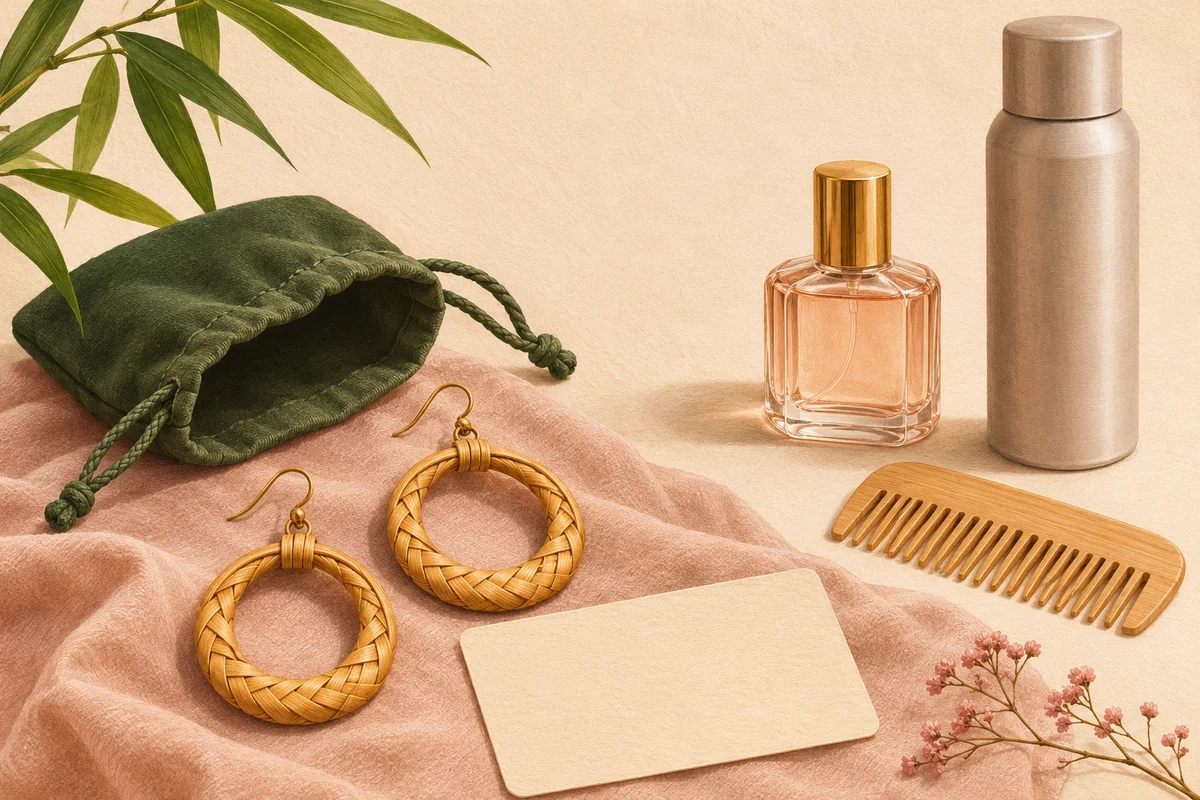
At a glance
Keep the earrings aside while applying perfume, hairspray or similar cosmetics, and put them on after application is finished without transferring the products to the jewellery. KineTimber’s published care instructions for bamboo earrings and hair ornaments say to avoid water, perspiration, perfume and alcohol, and keep metal fittings dry. No universal waiting time or chemical-resistant finish has been confirmed for the individual ER styles.
What does KineTimber’s care page actually confirm?
It confirms avoidance of water, perspiration, perfume and alcohol for bamboo earrings and hair ornaments. It also says to wipe dry after wearing, keep metal fittings dry and store the pieces separately in a soft pouch away from moisture, pressure and direct sunlight. Those are the published routine limits. They do not specify a solvent formula, cosmetic exposure duration or a coating performance test for every ER model.
Why put earrings on after cosmetics rather than spray around them?
Setting the earrings aside creates a distinct application stage and avoids intentionally spraying the woven body or hook. Keep them separate for later touch-ups as well. Follow the cosmetic’s own directions and check for transfer when handling jewellery afterwards; “wait five minutes” is not a confirmed KineTimber rule. The independent Timber Trace wooden-earring guide also puts cosmetics and wearing into separate stages, but its finish and materials are its own.
Does a metal hook make metal-jewellery cleaner suitable for the whole earring?
No. The supplied material information describes handwoven natural bamboo bodies and alloy earring hooks; the exact assembly includes different parts. A cleaner sold for a solid metal item is not automatically suitable for the attached weave, a colour treatment or an unknown finish. Identify which component a method is intended for before using it. Keep the hook/back guide beside the care page when asking about a particular ER reference.
Are alcohol wipes or hand sanitizer approved for these earrings?
They are not an approved method in the published routine; KineTimber explicitly says to avoid alcohol. Check a product’s label rather than treating every wipe as equivalent. An “alcohol-free” perfume also does not become permitted merely by that description, because perfume itself is listed among the contacts to avoid. If your intended routine requires a different cleaning method, resolve that requirement for the exact item before purchase.
Can oil or a new coating prevent cosmetic marks?
No protective treatment has been established here for ER-01 or ER-16. Keep the surface as supplied while asking for style-specific advice instead of adding oil, polish or a new coating. Timber Trace’s guide describes maintenance of its own named oil/wax finish; that is useful evidence that finishes matter, not permission to apply its renewal or abrasion instructions to KineTimber’s woven bamboo. A glossy photograph is not a finish specification.
What should I record if spray reaches an earring?
Set the piece apart from further spray and record the cosmetic’s label, when contact happened, the affected component and the visible condition. Do not try successive rinses, rubbing or coatings to make an unclear mark disappear. Normal published care is the starting point, but persistent residue or a changed surface needs item-specific advice before going beyond it. This record does not promise restoration or determine a return or warranty outcome.
How can ER-01 and ER-16 help with a practical choice?
ER-01 Blue & Teal Loop is published as 6.5 × 4 cm; ER-16 Natural Long Drop as 6 × 2 cm, with length including the hook in both cases. The visible forms and outlines differ, while the stated bamboo and fitting care still applies. These dimensions help identify the selected pieces, not compare chemical resistance. Neither a natural-looking colour nor a narrower body establishes an easier solvent-cleaning routine.
What belongs in my before-purchase care record?
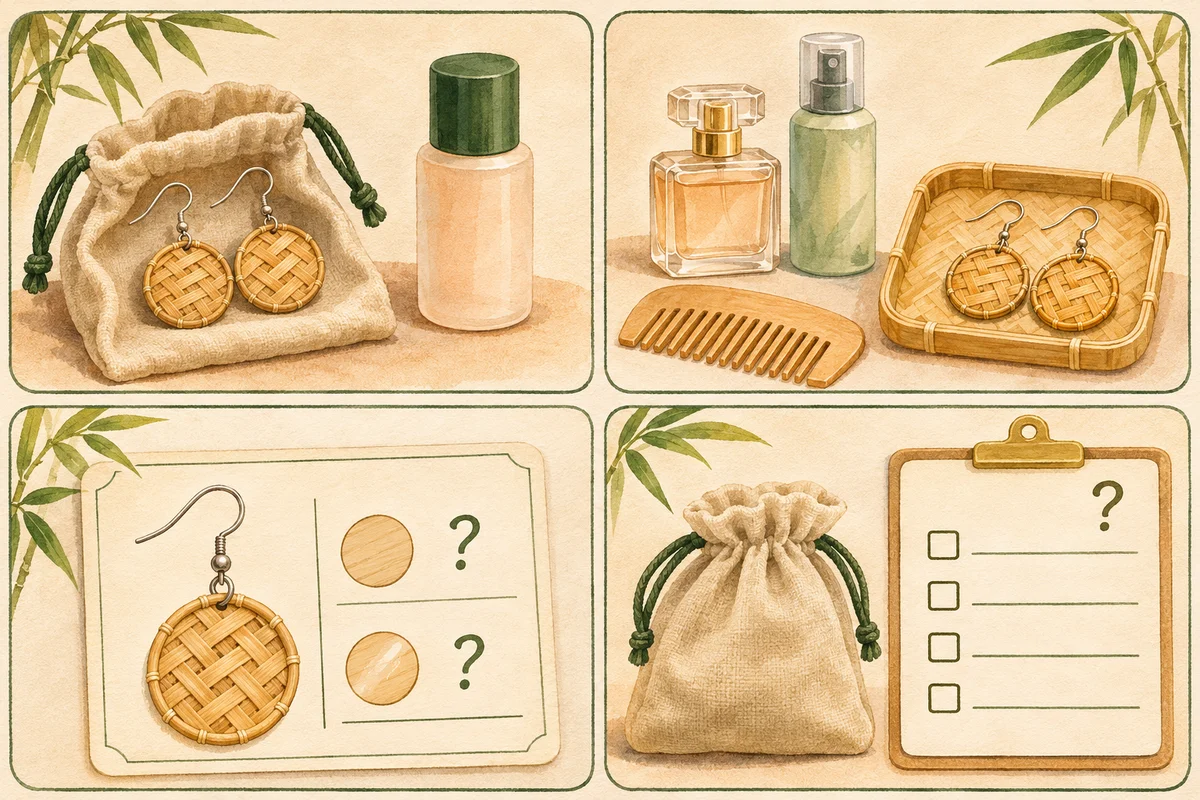
Record the ER reference, the care source and date, the cosmetics you actually use, the separate application stage and the parts whose finish remains unknown. Decide whether the published routine fits your needs before paying. If a necessary cleaning requirement is unresolved, ask with the precise model reference. The generic AI cover and four-panel illustration explain this sequence and record; they are not product photographs, treatment instructions or chemical-test results.
Put the guide into practice
Use one original care record for the exact earring and your actual cosmetic routine. Keep published facts, unknown finishes and any observed incident separate. The four text steps explain the illustration; no row certifies a new cleaning treatment.
- Read the exact ER reference and the published care page.
- Set the jewellery aside when applying or reapplying cosmetics.
- Finish the application and avoid transfer; do not invent a universal waiting time.
- Follow dry after-wear care and separate storage; ask before treating a persistent residue.
| What to examine | How to interpret it |
|---|---|
| ER-01 | 6.5 × 4 cm, length including hook; finish/exposure rating not established |
| ER-16 | 6 × 2 cm, length including hook; no chemical comparison result |
| Published care source | Date/link ___; avoid perfume/alcohol; keep fittings dry |
| Cosmetic application stage | Product label ___; jewellery set aside for application and touch-ups ___ |
| Separate components | Woven body / hook / back ___; finish or method unknown ___ |
| Observed incident | Date / cosmetic / affected part / visible condition ___; no improvised repair |
| After-wear storage | Wipe dry; separate soft pouch ___; moisture/pressure/sunlight check ___ |
| Decision and unknowns | Required routine ___; unresolved finish/method ___; ask / shortlist / wait ___ |