The journal
Could a woven bamboo bag be crushed inside a suitcase?
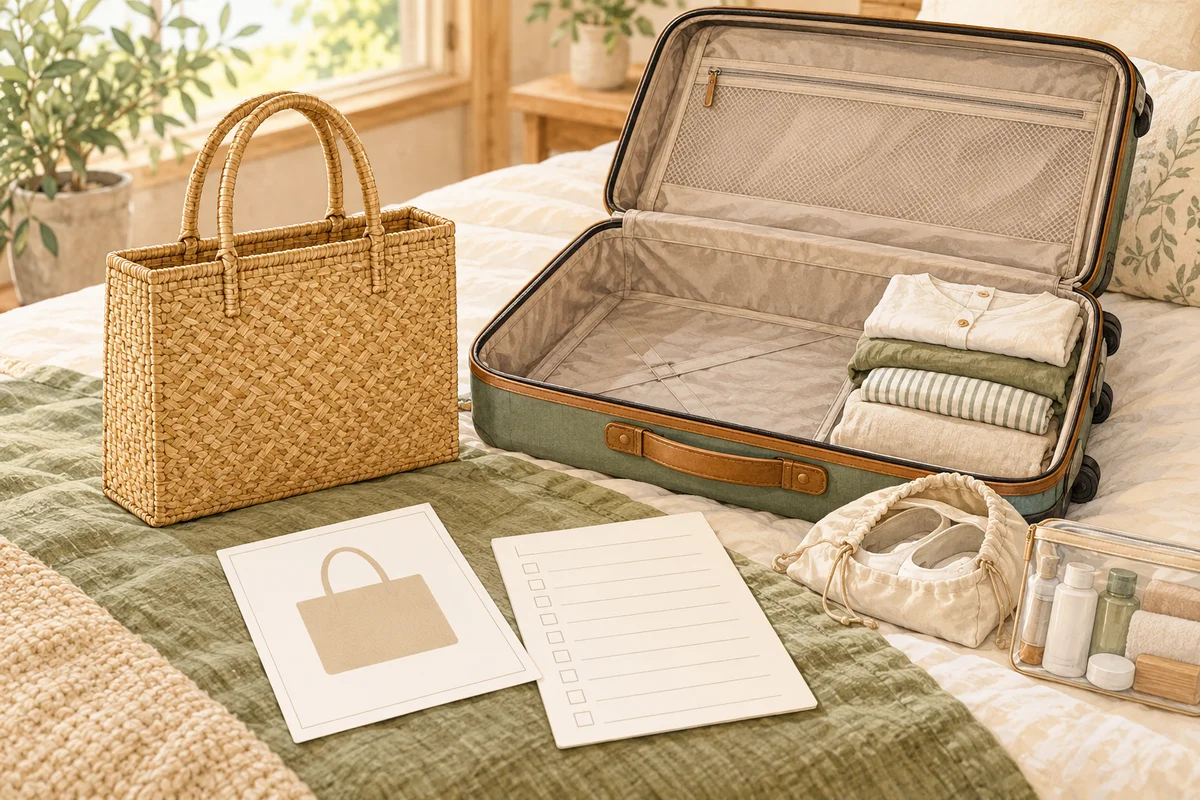
Plan suitcase space around the complete bag shape, handles and nearby objects. Record pressure sources before packing; no crush resistance is confirmed.
At a glance
It could: the published details checked here do not establish crush resistance for these KineTimber bags. Plan around the complete, unchanged bag shape rather than treating the weave as foldable. Check handles, the suitcase’s usable space and objects that could press against the bag. If the arrangement needs the lid, divider or straps to squeeze it into place, rearrange or choose another carrying plan. A successful space check does not prove that the bag will arrive undamaged.
Does a woven surface mean the bag can be folded flat?
No. A woven appearance does not document how the whole construction behaves when folded. Eric Javits explicitly calls its own Lil Kumi a rollable bag; that is wording for that item, not permission to roll a bamboo frame bag. Its page also uses differing material descriptions, so we do not use it as a material comparison. No folding or rolling instruction was found in the KineTimber details checked for WB-03 and WB-05. Leave their original structure unchanged and do not bend a handle or frame to save space.
Which published bag measurements help with packing?
Use the measurements with their stated scope. WB-03 lists natural bamboo and natural wood, at 29 × 13 × 24 cm, with height excluding the handle. Its full packing height therefore remains unconfirmed by that number. WB-05 lists natural bamboo and textile, at 8 × 8.5 × 15 cm, with height including the handle. These are external dimensions, not internal capacity or crush ratings. Neither set alone confirms clearance around protruding details or fit in your particular suitcase. Record the reference and measurement scope before comparing.
How should I compare the whole bag with my suitcase?
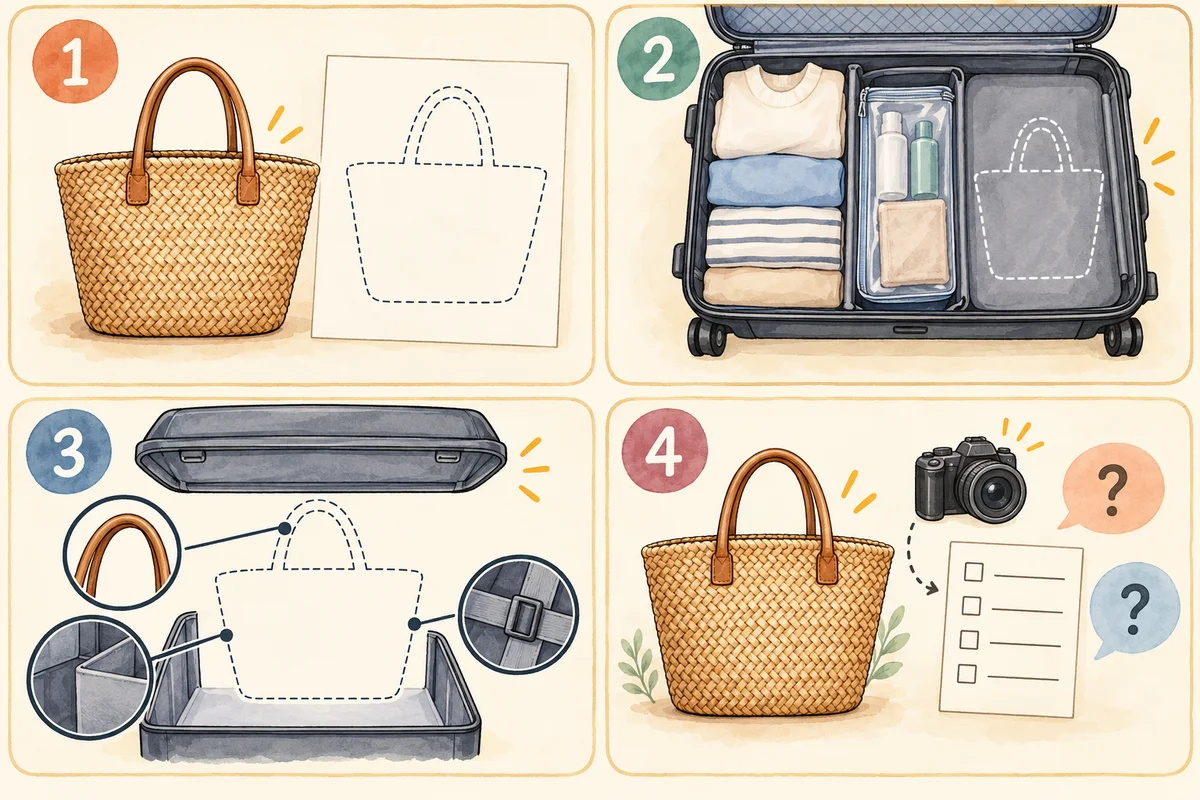
Compare the complete bag outline with usable space inside the open case, not its advertised outside dimensions. If you have the bag, measure it without compressing it, including fixed handles and protruding closures in the intended orientation. Note suitcase wheel housings, internal bars, curved corners and the divider’s position; these can interrupt an apparently rectangular space. Sarah Bray Bermuda’s bucket-bag page separately describes basket dimensions without handles, another reminder to read measurement scope. If buying before measuring the real bag, ask for the missing overall dimensions and keep fit unresolved.
Which surrounding objects should I move first?
Start with hard or heavy objects touching the bag’s outline: shoes, books, bottles, chargers and rigid cases. Give these their own position so an edge or corner is not aimed into the weave, handle or closure. A clean, dry, soft separation layer may reduce direct rubbing, but is not a pressure shield. Also consider where those objects could move when the suitcase changes orientation. Record the arrangement rather than assuming that putting the bag on top solves every contact. Wet items and liquids need separate planning; the rain-care guide covers moisture handling.
Can I fill the bag to keep its shape?
Do not force filling against the sides or use the bag as a container for hard packing items. If you choose to place a clean, dry, soft item loosely inside, it should occupy existing space without stretching the opening, pushing the weave outward or loading the handle. Leave it out if you cannot do that without pressure. This is an optional arrangement idea, not a manufacturer-tested support method or an internal-capacity claim. Internal dimensions and the opening still need their own check; the phone-fit guide explains why outside measurements cannot settle them.
What should I check before closing the suitcase?
Check that the handle, closure and body stay clear of the lid, divider, zipper path and tensioned luggage straps. Bring the lid toward its normal position gently, without using it to compress the bag. Stop if contact would bend a part, alter the outline or require force; remove the bag before rearranging nearby items. Do not sit on the case, pull the zipper against resistance or tighten a strap across the bag to make it fit. This is a packing-space check only. It does not simulate transport loads or establish a safe pressure threshold.
What if I cannot leave enough space?
Change the plan before forcing the bag into the case. Remove or relocate other items, choose another piece of luggage, or consider a different bag with documented packing instructions suited to the trip. Carrying it separately may give you more control of nearby objects, but does not itself guarantee protection. Confirm any operator’s applicable baggage rules separately; this guide does not confirm cabin acceptance or airline size compliance. If buying mainly for repeated suitcase packing, ask about the exact model’s complete dimensions and packing instructions before ordering, and leave undocumented performance unknown.
What should I record for the outward and return journeys?
Record the bag reference, full outline, suitcase space, nearby hard items and any unresolved contact before departure. A photo of your own arrangement can help you rebuild it, but is not proof of crush resistance. At arrival, unpack without pulling the bag through a tight gap and look for changed shape, loose connections or visible damage before using it again. If you see a change, stop bending or reshaping it and ask about the exact item with your dated observations. Recheck the return layout because added purchases and moved clothing change the available space. One uneventful journey is not a future damage guarantee.
Put the guide into practice
Complete this record for your own outward journey, then update it for the return. Use unknown where a measurement or instruction is missing; this is a planning record, not a pressure test.
- Record the exact bag and its complete, uncompressed outline, including handles.
- Plan usable suitcase space and separate hard objects, leaving the bag’s shape unchanged.
- Before closing, check lid, divider, zipper path and straps without pressing the bag.
- Save your arrangement record, inspect visually on arrival and recheck the return layout.
| What to examine | How to interpret it |
|---|---|
| Item and trip | WB reference/version: ____; outward/return date: ____; page/source date: ____. |
| Complete bag outline | L × W × H + unit: ____; handle included: ____; protrusions/orientation: ____; missing: ____. |
| Usable suitcase space | Clear space + unit: ____; wheel housings/bars/corners: ____; divider position: ____; source: ____. |
| Nearby hard items and separation | Shoes/books/bottles/cases: ____; relocated to: ____; soft separation: ____; possible movement: ____. |
| Closure contact and decision | Lid/divider/zipper/strap contact: ____; changed outline or force needed: ____; rearrange/other plan: ____. |
| Arrival and return record | Dated arrangement photo: ____; visible change on arrival: ____; question to resolve: ____; return additions/revision: ____. |